
Commercial construction financing is a short-term loan that pays for building or substantially renovating a property that earns income or houses a business. The lender releases the money in stages as inspected work is finished, then you repay it with a permanent loan, a refinance or a sale. If you have only dealt with a home construction loan, the logic is familiar but the underwriting is different: lenders look at the project's income, not your paycheck, and they expect you to bring 20% to 35% of the cost yourself. The smoothest projects pair that financing with a licensed, bonded and insured local builder who keeps the numbers and the schedule visible to everyone, which is how we work at Verity Construction.
This guide is for homeowners who are also thinking about a business building, a rental property or a mixed-use project, and who want to understand how that financing differs from the home loan they may already know.
TL;DR
- A commercial construction loan funds land, hard costs and soft costs for a new or substantially renovated income-producing or business property, and pays out in draws after inspections.
- Expect to contribute roughly 20% to 35% equity. Interest is paid only on the money drawn, and the loan is typically repaid within one to three years by a permanent loan, a refinance or a sale.
- Lenders underwrite the project's projected income, the builder's contract and budget, and the people behind the borrower, including when the borrower is an LLC.
- Costs go beyond interest: origination fees of roughly 1% to 2%, inspection time between draws, and an interest reserve and contingency to cover delays.
- A realistic line-item budget and a builder who reports progress clearly make every draw easier to approve.
Table of Contents
- What commercial construction financing actually covers
- How it differs from a home construction loan
- The loan process, step by step
- What lenders require
- What it costs
- Where projects go wrong
- Choosing the builder who sits behind the loan
- FAQ
- Sources
What commercial construction financing actually covers
Federal regulators define the category fairly plainly. The National Credit Union Administration describes a construction and development loan as financing that lets a borrower acquire property with the intent to construct or renovate an income-producing or commercial property. Routine maintenance or repairs on an existing building that do not change its use are not in that category.
The Office of the Comptroller of the Currency, which supervises national banks, says these loans finance construction or renovation of properties other than one-to-four-family homes, whether the owner will occupy, lease or sell them. Apartments, office buildings, retail centers, hotels, industrial buildings and mixed-use developments all qualify.
In practice the money can go to:
- Buying and developing raw land
- Labor, building materials, and contractor and subcontractor fees
- Expanding or renovating an existing building
- A cash reserve for competitive bidding
That list comes from a Wall Street Journal buying guide on commercial construction loans, published October 2026.
The loan is usually sized as a percentage of total project cost, not of the finished value. Money for land, hard costs (the physical building) and soft costs (design, permits, fees) comes out in draws, and many loans include an interest reserve, a portion of the loan set aside to make the monthly interest payments during construction.
How it differs from a home construction loan
If you are building or remodeling your own house, you have likely seen the consumer version. A bank lends against the home you will live in, pays the builder in stages as each phase passes inspection, and charges interest only on the drawn balance. A one-time-close loan then converts to a 15- or 30-year mortgage when the house is finished, as one community bank's guide describes. Lenders underwrite you, your builder and the plans, with the home valued as completed.
Commercial financing keeps the draw structure but changes what matters:
| Home construction loan | Commercial construction loan | |
|---|---|---|
| What secures it | Your future primary home | An income-producing or business property |
| What the lender studies | Your income, credit and the plans | Projected net operating income, the budget, the builder and the sponsors |
| Typical equity | Varies by program | 20% to 35% of the project |
| Decision process | Few people involved | More formal, with approvals at each milestone |
| Typical end of loan | Converts to a mortgage | Permanent loan, refinance or sale |
The practical takeaway: a commercial lender asks whether the building will pay for itself. Rent rolls, lease commitments, or the business's own cash flow carry the application, which is why a clean, line-item budget matters so much.
The loan process, step by step
Lenders vary, but the sequence is consistent. One published eight-step outline runs from an initial discussion through application, builder contracts, underwriting, appraisal, closing, construction draws and permanent financing. Here is what each stage asks of you and where projects stall.
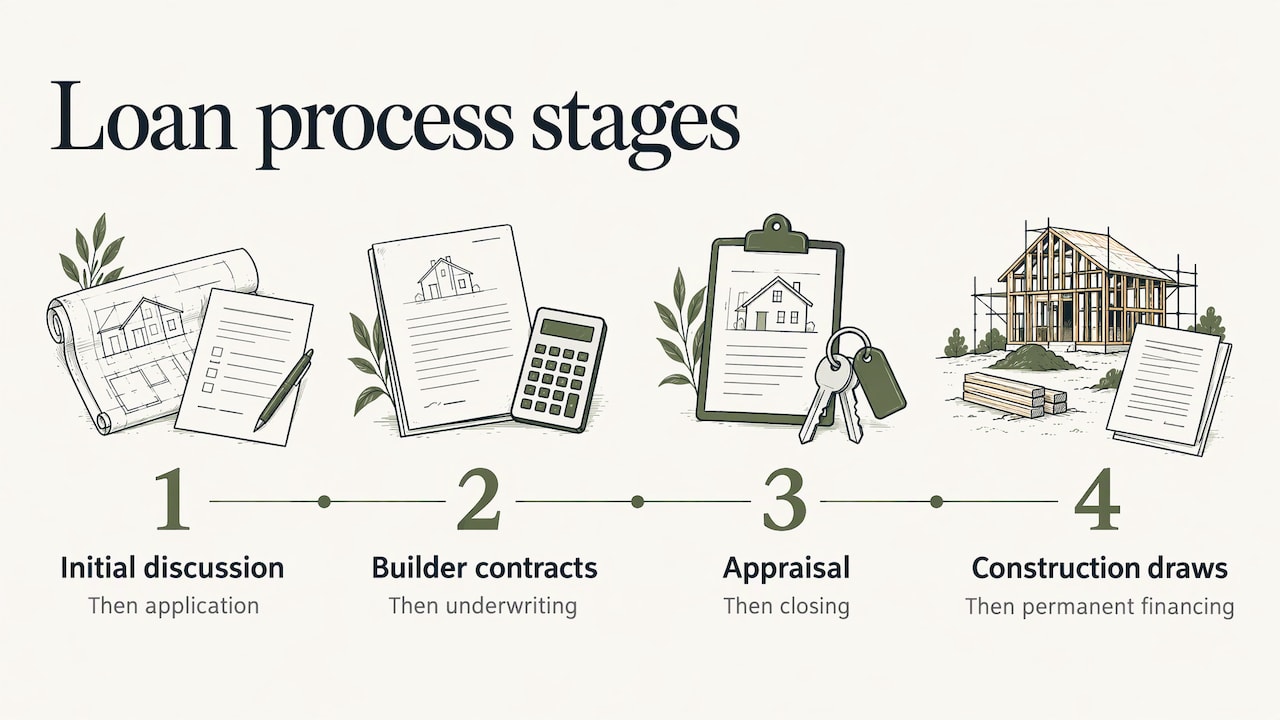
1. Define the project and talk to a lender early
Bring a concept, a site, a rough budget and a sense of who will occupy the building. Lenders want to know the source and timing of repayment, and whether projected income supports the expected value on completion. Projects stall here when the budget is a round number instead of a built-up estimate.
2. Get a firm contract and budget from your builder
The lender will want the builder's contract and a detailed budget. Regulators expect a qualified person to review and approve the line-item construction budget before closing. Budgets with vague allowances cause delay, and a builder who can show scope, schedule and costs in detail speeds this step. Our design-build process is organized around planning before construction starts, so the numbers you hand a lender reflect real scope.
3. Apply, then go through underwriting and appraisal
The lender evaluates the borrower, the sponsors, the builder and the project, then orders an appraisal. Collateral is valued at the lesser of cost to complete or the project's prospective value in credit union guidance, so a low appraisal can shrink the loan and raise the equity you must bring.
4. Close and set the draw schedule
At closing you contribute the down payment and agree to a draw schedule tied to project milestones. Regulators say a bank's policy should require borrower equity to be contributed before construction loan disbursements begin.
5. Build and draw
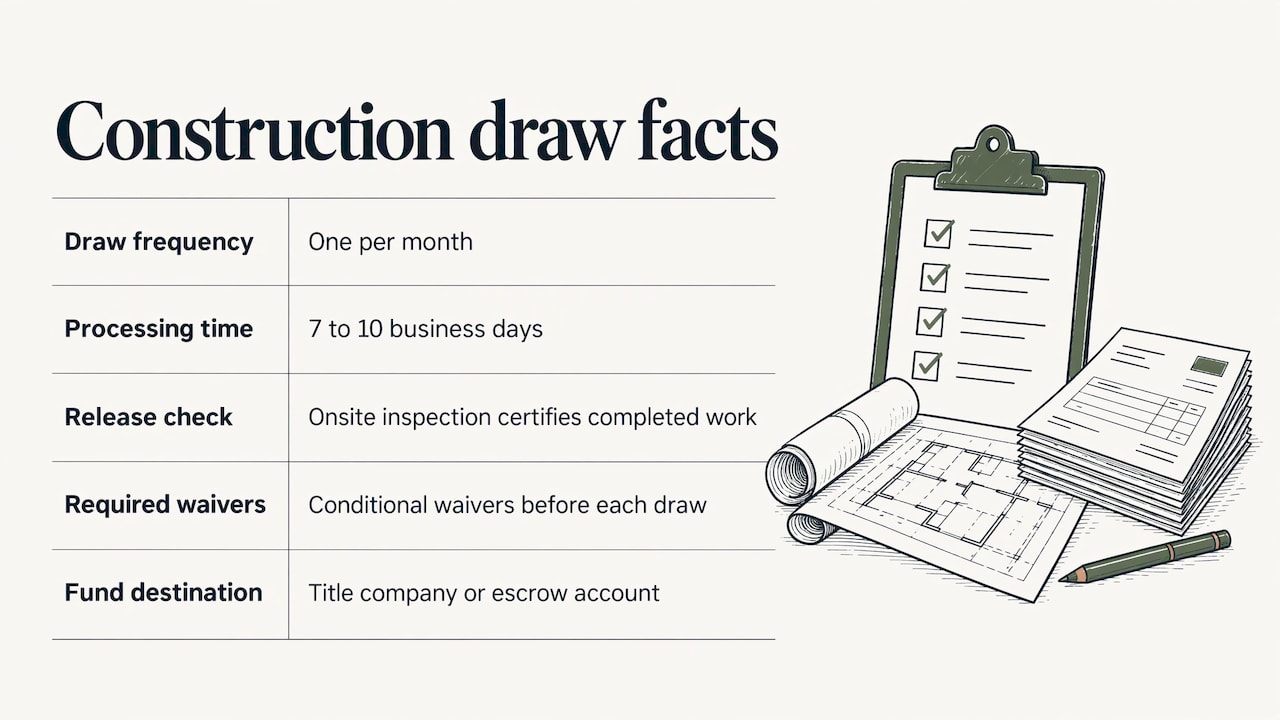
To request a draw, the builder documents completed work. The lender's inspector checks it, and funds go out only after onsite inspections certify the work is complete and the remaining funds can finish the project. One bank's published construction documents state that disbursements are limited to one per month, with 7 to 10 business days to process a request, so plan cash flow around that gap.
Many lenders send funds to a title company or escrow account rather than to you, and require conditional lien waivers from the general contractor and major subcontractors before each draw to prevent mechanics liens. Draws slow down when paperwork lags behind the work, so clear, timely project updates from your builder have real financial value.
6. Finish, release retainage and move to permanent financing
Lenders normally hold back 10% to 20% of each payment as retainage, paid with the final draw after a final inspection and, where needed, a certificate of occupancy. You then repay the loan through a permanent loan, a refinance or a sale. A stand-alone construction loan typically covers only the building phase of about 6 to 18 months, so line up the permanent financing before the loan matures.
What lenders require
Equity
Expect to put in real money. Most lenders ask for 20% or more down, in a range of 10% to 30%, and SBA-backed loans can go as low as 10%. Federal guidelines set an 80% loan-to-value ceiling for commercial and multifamily construction. Lenders also look at loan-to-cost, which the OCC says helps ensure the borrower contributes enough equity, because that equity cushions cost overruns and leasing or sales shortfalls.
Not everything counts as equity. The OCC notes that deferred developer profit, unearned developer fees and incurred overhead are generally not considered equity. Cash and land you own outright are the strongest contributions.
Borrower strength
Lenders weigh personal credit, liquidity and experience. One LendingTree guide says most commercial construction lenders look for a personal credit score in the high 600s to low 700s and a debt-to-income ratio of 43% or lower. Construction lending guidance from the Associated General Contractors of America adds that lenders rarely finance 100% of costs and look for a debt service coverage ratio above 1.0, typically 1.2 to 1.6. That ratio compares the property's income to its loan payments.
Can an LLC borrow?
Yes. Setting up an LLC for a specific build is standard practice for liability protection. A new LLC has no credit history, so lenders evaluate the people behind it: personal credit, development track record and liquidity. Expect to sign personal guarantees in many cases, so confirm the terms with your lender and attorney.
The SBA route for owner-occupied buildings
If your own business will occupy the building, SBA-backed financing can lower the equity requirement. An SBA 504 structure splits the project into a 10% borrower down payment, 40% from a certified development company and 50% from a bank, with 10- to 25-year terms. The business must occupy at least 51% of the property initially (60% for some new construction) and at least 80% for the rest of the loan term. Rules and limits change, so confirm them with an SBA-approved lender.
What it costs
Interest is only part of the bill.
- Interest rate. Construction loans commonly carry variable rates tied to SOFR or prime. In its October 2026 guide, one lender reported spreads of 200 to 400 basis points above the 10-year Treasury yield. The Treasury yield moves daily, so use a live quote from your lender rather than any published figure.
- Origination fees. The Wall Street Journal guide cites about 1.00% of the loan amount, while another October 2026 lender guide puts the typical range at 1% to 2%. On a $2 million loan, that is $20,000 to $40,000 at closing.
- Loan sizing. Loans are typically capped at 65% or 75% loan-to-cost and 60% to 70% loan-to-value, so the equity you bring can be larger than a headline percentage suggests.
- Interest during construction. You pay interest only on what has been drawn, so early months cost little and later months cost more. If a budgeted interest reserve runs out because of delays, the borrower is expected to fund the shortfall.
- Contingency. Lenders' budgets usually carry a contingency allowance of 5% to 10% of the overall budget.
A worked example
Suppose a $2,000,000 building with a lender capping loan-to-cost at 75%. The loan is $1,500,000, and you bring $500,000 (25%). If the lender charges a 1% origination fee, that is $15,000 at closing. If you have drawn $600,000 by month five, interest accrues on $600,000, not on the full $1.5 million. Add a 7.5% contingency, $150,000, to the budget before you set the loan amount, because overruns come out of your pocket, not the lender's.
Where projects go wrong
The OCC lists the main threats to completing a funded project: cost overruns from inaccurate budgets or material shortages, liens for nonpayment, contractor failure, labor disputes and loan administration errors. Most of these trace back to two things: a budget built on guesses and a builder who cannot show progress clearly.
The fixes are practical:
- Price the project from a detailed scope, not a per-square-foot guess, before you apply.
- Carry a contingency and an interest reserve in the loan budget.
- Match the draw schedule to the real construction sequence.
- Collect lien waivers with each draw request.
- Confirm your permanent financing path before closing the construction loan.
Choosing the builder who sits behind the loan
A lender is underwriting the builder as much as the borrower. A licensed, bonded and insured local team with a record of transparent project updates gives the lender and you a clear picture each time a draw comes due. That is the standard we hold ourselves to at Verity Construction.
We are a Medford, Oregon builder serving Southern Oregon, and our commercial work covers professional offices, tenant improvements, retail stores and multi-family development. If you are weighing a commercial project, our commercial builder page shows what we build, and you can see a finished example in our Southern Oregon office renovation. Our team has more than a decade of experience, and we work with owners directly from design through the final walkthrough.

If you are planning a commercial build in Medford or the surrounding area, contact our commercial team to talk through scope and schedule before you go to a lender. Planning a house instead? Our custom home page covers that work.
FAQ
Do I have to put 20% down on a commercial construction loan?
Usually something close to it. Most lenders ask for 20% or more, with a common range of 10% to 30%, and some guides cite up to 35%. SBA-backed loans can require as little as 10%. Your lender sets the exact figure after reviewing the project and your finances.
How much would a $100,000 construction loan cost per month?
During construction you pay interest only on the amount drawn, so the payment starts small and grows. At a hypothetical 9% rate, a fully drawn $100,000 would be about $750 a month in interest. Your actual rate depends on the lender and the index it follows, so ask for a current quote.
Can my LLC get a construction loan?
Yes. Many builds are held in a single-purpose LLC for liability protection. Because a new LLC has no credit history, lenders look at the owners' personal credit, development experience and liquid assets, and often ask for personal guarantees.
How long does a commercial construction loan last?
Terms commonly run one to three years, and some are as short as six months. SBA-backed structures can extend as long as 25 years. At the end you repay in full, refinance into a permanent loan or sell the property.
Is commercial construction financing the same as a home construction loan?
They share the draw-and-inspection structure, but commercial loans are underwritten on the property's projected income and usually need more equity. A home construction loan focuses on your personal finances and the home you will live in.
Sources
- NCUA, Construction and Development Loans
- OCC, Commercial Real Estate Lending, Comptroller's Handbook
- Wall Street Journal, Commercial Construction Loans: How They Work
- V3 Lending, Commercial Construction Loans
- Herring Bank, Construction Loans: How They Work
- Crestmont Capital, Construction Loans for Small Business
- Acon Engineering, Residential vs Commercial Construction
- Banks.com, How to Get a Commercial Construction Loan
- Live Oak Bank, Construction Documents
- SCORE Commercial Capital, Commercial Construction Lending for Developers
- LendingTree, Commercial Construction Loans
- AGC Guide to Construction Financing
- Commercial Builders & Contractors, Commercial Construction Loan
- Texas Gulf Bank, How Does an SBA Commercial Construction Loan Work?